Despite having eliminated those famous films from my list, there remains an staggering amount that I still have never seen. So this month, in choosing older movies, I set about on an ambitious journey by single-mindedly focusing on those "classics" I felt most guilty about having missed. Even given the considerable reputation of all of these films, I knew I wasn't going to like everything. Still, I feel very relieved to be able to say I have, at long last, seen Sophie's Choice. With the arrival of summer, I found myself freed from the responsibility of having to watch the ten or so regular TV series I still follow, which left a lot of extra time to watch films. And with 29 total on the docket, that was very nearly a film a day for the month of June.
So what did I learn? Two things: first, just because a movie is universally considered to be a classic, that doesn't automatically mean it's good; and second, I'm not so simpatico with the whole "antihero" craze—after failing to be charmed by Jake LaMotta (Raging Bull), Tony Manero (Saturday Night Fever), Lewis Medlock (Deliverance), Sonny Wortzik (Dog Day Afternoon) and Jim Stark (Rebel Without a Cause), I think I can safely say that unlikable and unsympathetic male leads in movies are not my cup of tea—Hud being a notable exception.
I intend to balance everything out in July by leaping back into the obscurities pile with a special program of "Movies You've Never Heard Of." In some ways, I am more excited about watching those.
FIRST-RUN FILMS

A LITTLE HELP (2011)—A somewhat overlong dramedy that casts cutie-pie Jenna Fischer (Pam from TV'sThe Office) as Laura, a woman suffering from a variety of problems—cheating spouse (Chris O'Donnell), unappreciative son, bitchy sister, condescending mom—that no amount of beer and cigarettes can make go away. And then things suddenly take a turn for the worse. The movie's theme is how lies infect the soul: how they grow, like a cancer, and end up spoiling life. There are good turns by Ron Liebman and Lesley Ann Warren as Laura's parents, and Kim Coates as a shifty attorney—the embodiment of dishonesty. It's not a great movie, but I found myself caring about the characters, warts and all (for once, Fischer is photographed in a way that is not especially attractive). A nice effort by first-time feature writer/director Michael J. Weithorn. (8)
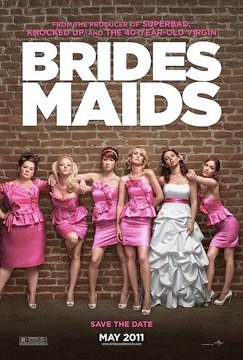
BRIDESMAIDS (2011)—The filmmakers rope the audience in with the promise of dirty jokes and raunchy toilet humor, but send you home with a couple of touching redemption stories and an unexpected tear in your eye. Kristen Wiig, the talented comedienne of Saturday Night Live, co-wrote and stars in this occasionally sophomoric comedy about a woman whose best friend since childhood (SNL's Maya Rudolph) is about to get married. But gathering the bridesmaids together throws a stick into the spokes when another close friend of Rudoph's—the absurdly rich and stunningly beautiful Rose Byrne—ignites a tragicomedy of jealousy and hurt feelings within Wiig, eventually causing her life to unravel. At its best, the film wavers between amusing absurdity and laugh-out-loud hilarity, much of it deriving from jokes about Byrne's wealth and high standing, and she all but steals the movie from Wiig; love interest Chris O'Dowd, meanwhile, establishes himself firmly as the Irish Judge Reinhold. (9)

SUPER 8 (2011)—SPOILER ALERT: A alien from another planet is helped by a group of children to go back home, while all the mean adults just want to hold him hostage and study him. Hey, wait a minute...isn't that the plot to another movie? The summer blockbuster of 2011 gleefully rips off the summer blockbuster of 1982. J.J. Abrams' film is a generally entertaining, but equally confounding, tribute to both Steven Spielberg's sci-fi movies and to his own childhood passion for filmmaking. It's all about the 1970s, and great attention to detail has been given to conjure up an authentic Seventies feeling. But the filmmaker doesn't commit himself to the story—there are entirely too many references to Spielberg films, even cribbing specific pieces of dialogue, to the point where it becomes too distracting. Probably the year's biggest letdown, not because it's awful, but because it could have been so much better. (7)
THE "CLASSICS" I SOMEHOW MISSED
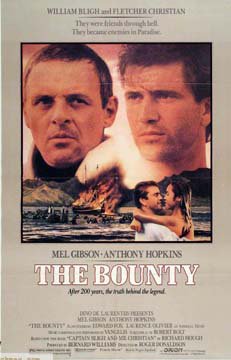
THE BOUNTY (1984)—To be a real "purist" during this month's project, I ought to have started with the Clark Gable version of Mutiny on the Bounty (or the almost-as-famous Marlon Brando remake). But I thought it might be interesting to start with this update, which pits Anthony Hopkins' Capt. Bligh against youthful Mel Gibson's Fletcher Christian. (Mind you, I made this decision well before I had any inkling that there would be a steady stream of beautiful topless island women on display.) Because it's told in flashback, this telling of the story establishes from the get-go that Gibson—who starts out as Hopkins' buddy—is going to play a major role in the mutiny that follows, which sort of blunted a bit of the suspense for me; I'm not sure if earlier versions of the story take the same approach. Also, this version is supposed to humanize Capt. Bligh somewhat, although he is still a bit of a psychopathic madman. While I enjoyed it for the most part, it doesn't really add up to much except a mildly interesting history lesson. (8)

RAGING BULL (1980)—At long last, another classic to scratch off the cinematic bucket list. Thirty years ago, it seems everybody except me watched Jake LaMotta (Robert DeNiro) implode on the screen as the middleweight fighter who destroys competitors in the ring while simultaneously destroying his personal life with his nasty jealous streak. As I've repeated made clear in my blog, it's always a struggle for me to enjoy movies where the central character doesn't have an ounce of likability or empathy, and DeNiro plays LaMotta as 100 percent unsympathetic. (It should also be said that I've never been a fan of the dark and gritty oeuvre of Martin Scorsese, whom I acknowledge is one of the country's most popular and respected film directors. That being said, I very much enjoyed his comedy After Hours and his "Life Lessons" segment of New York Stories.) Like The Bounty, Raging Bull serves as a peripherally interesting history lesson, but as a piece of entertainment, it's a struggle to endure. The boxing scenes are some of the bloodiest and most gruesome I've ever witnessed. (6)

GOODBYE, MR. CHIPS (1939)—Robert Donat is amazing in this story of a British schoolteacher whose 63-year career unfolds in just under two hours. His makeup and acting are extremely impressive as we watch him transform from a relatively young man to a sprightly old geezer. Greer Garson appears as his love interest. Sentimental but good fun; based on the novel by James Hilton, who in turn based Mr. Chips on his real-life teacher at Cambridge. (8)

BREAKFAST AT TIFFANY'S (1961)—Paul Varjak (George Peppard) is a writer who lives in an apartment upstairs from Holly Golightly (Audrey Hepburn), with whom he falls madly in love—attracted, I assume, to her rudeness, selfishness, illogical behavior, dipsomania, greedy addiction to expensive jewelry, illegal undertakings (she delivers coded messages to an underworld mob boss in Sing Sing), general mischievous impulses and lack of imagination (she can't be bothered to think of a name for her pet cat). And Paul overlooks the fact not only that she had her first marriage (to Jed Clampett!) annulled, but also that she doesn't even bother to tell him (Peppard) that she was married and divorced at all. And why does Paul overlook all of her flaws? Because she's pretty and she has a British accent, of course! Another thing Holly does is smoke constantly, which as anybody who knows me can tell you is an immediate turnoff—how disgusting and off-putting it is that the iconic image of Hepburn clutching her oversized cigarette holder did so much to glamorize smoking. (Hepburn died of cancer.) Half of the "jokes" in this alleged comedy involve an ridiculously stereotyped caricature of a Japanese landlord (played by Mickey Rooney) bellowing that he "gonna call the po-reece on Horry Gorightry" because she's always losing the keys to her apartment and having to buzz him to let her in, or making a racket, or whatever. Paul and Holly wind up together at the end, but how long will they stay together before he strangles her? (5)

REPULSION (1965)—Director Roman Polanksi's first film in English, it's a psychological thriller about a pretty girl who is becoming progressively more unglued—it's Black Swan without the ballet. In fact, if I'd seen this film prior to Black Swan, I'd probably have viewed the 2010 Natalie Portman flick as wildly derivative of Polanski, and retroactively, I definitely do. I expect quite a lot of films have borrowed from Repulsion. It brought to mind a horror movie I saw last year, Fright, which starred Susan George as a similarly beautiful blonde woman alone at night and fending off attackers, although hers were all real, none imagined. Repulsion is definitely a creepy film, perfect for watching late at night. (8)

SATURDAY NIGHT FEVER (1977)—This is one of the top-five "iconic" films released during my lifetime that I inexplicably missed. I have always really enjoyed the soundtrack music, but nothing about the movie ever compelled me to watch—I just find it boring to watch people dance (at least to disco). I forced myself to sit through the film just to finally say I've seen it, but it was rough going because I couldn't muster the strength to care about the protagonist, Tony Manero (John Travolta) or any of the other characters, for that matter. Travolta is a curious entertainer; I find I either love him (Urban Cowboy, Pulp Fiction) or despise him (Blow Out, Hairspray). This one has aged terribly. (4)

HOLIDAY INN (1942)—Bing Crosby and Fred Astaire in the famous Irving Berlin musical that contains romantic hijinks, big production numbers and lots of great songs. The chemistry between the two leads (and female star Marjorie Reynolds) is copious. Plenty of good humor and melody. (9)

SHANE (1953)—Alan Ladd is the mysterious hero who rides into the lives of homesteader Van Heflin and his family and winds up working for them—and protecting them from some vicious bad guys. (Pretty much the plot of every Western.) Beautifully realized, directed and filmed, with some excellent brawls. (9)
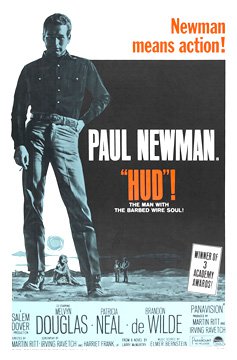
HUD (1963)—Paul Newman won much acclaim for his role as Hud, the selfish and snide title character, son of a deeply moral Melvyn Douglas (the apple didn't just fall far from this tree; it fell in the next continent). Hud drinks, sleeps with married women and apparently contributed to the highway death of his older brother some years before; his nephew (Brandon De Wilde) nonetheless idolizes Hud, and their relationship is key to the success of the film, as the kid must choose between grandpa and uncle (i.e., good and evil). Patricia Neal won an Oscar for her portrayal of the family housekeeper, who tries to resist Hud's advances. One of the best movies ever to contain a cow holocaust! (9)
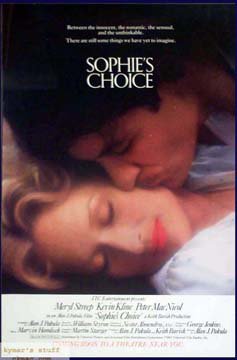
SOPHIE'S CHOICE (1982)—I have no idea how I missed this one. Based on a very popular William Styron novel, the film version (I guess) sounded a bit boring to me in my youth, but I'm glad I finally got around to watching it. Meryl Streep is fascinating to watch as Sophie, a concentration camp survivor who balances a romance with cuckoo-for-Cocoa-Puffs Kevin Kline and gentle writer Peter MacNicol (later of Ally McBeal). Quite compelling. (9)

ONCE UPON A TIME IN THE WEST (1968)—Here's director Sergio Leone's follow-up to his "Man With No Name" trilogy, a Spaghetti western that casts Henry Fonda in an atypical role as a sadistic killer. Fonda wants to steal luscious Claudia Cardinale's land, but she is protected by Jason Robards and Charles Bronson, the latter of whom has a very personal vendetta against Fonda. The movie is long (175 minutes) but generally mesmerizing, with cool directorial touches throughout. Watching this film, it's easy to see what inspired Quentin Tarantino; meanwhile, it has inspired me to watch the original Clint trilogy, as well as Leone's follow-up to this film, Duck You Sucker. (9)

DELIVERANCE (1972)—I was generally familiar with the story of this film, and have seen the famous "squeal like a pig" scene on TV (where it was obviously truncated), but I've never actually watched the film from beginning to end. Jon Voight, Burt Reynolds, Ned Beatty and Ronny Cox ill-advisedly take a canoeing trip down a river and run afoul of dangerous rapids and rednecks. I kept thinking, "Well, this is what you get for not staying at home." Reynolds in particular is an extremely arrogant "protagonist" I had a hard time sympathizing with. All the hillbillies in the movie (especially the inbred banjo player) are terrifying. (6)

SOUNDER (1972)—Released the same year as Deliverance, Sounder is quite a different kind of film. Set during the Great Depression, Paul Winfield is a poor black sharecropper who, along with Cicely Tyson, raise their young kids and often have to send them to bed hungry. When Winfield is sent to jail for stealing food for his family, their son David Lee (Kevin Hooks) makes a trek to the "pen" to see his dad. The movie is based on William H. Armstrong's novel, which I presume contains more about the titular dog. Right before seeing this film, I had finished reading Kathryn Stockett's novel The Help, which is also about pure-hearted black people and despicably racist whites. Interestingly, Cicely Tyson is in the movie versions of both stories. (7)

WHITE CHRISTMAS (1954)—I was curious to see how this Irving Berlin musical compared to his earlier Holiday Inn, which also starred Bing Crosby. Inn co-star Fred Astaire was asked to appear in this film, but turned it down after he read the script; he was replaced by Danny Kaye. Although not as charming or well-written as Holiday Inn, it is a very similar film—not exactly a remake, but not exactly a different movie either—about show-biz singers who popularize a hotel by doing their act there. Similar romantic hijinks make up the plotlines of both movies as well. The best thing in this film are funny Danny Kaye and the typically tuneful Irving Berlin songs. Oh, and Vera-Ellen is a genuine cutie pie (while her movie sister, Rosemary Clooney, is rather plain in comparison). (7)

GRAND HOTEL (1932)—Birth, life, death, love…and, inescapably, money. They all configure in this lavish, soapy drama, the grandaddy of all "multiple characters under the same roof" genre (last month's Ship of Fools is another example). Guests—and permanent residents—of Berlin's Grand Hotel include a lonely ballet star (Greta Garbo), a crooked industrialist (Wallace Beery), a dying employee of the former (Lionel Barrymore), a thief with a heart of gold (John Barrymore, Lionel's real-life brother), a pretty stenographer (Joan Crawford) and a disfigured WWI veteran (Lewis Stone). Most of them cross paths in important ways, and not everybody gets out of the hotel alive…based on an Austrian novel, which was turned into a successful play by the screenwriter of this movie—which is notable for being the only film to win a Best Picture Oscar without being nominated in any other category. Young Crawford, by this time a veteran of dozens of movies, is still unrecognizable as the rather scarifying Mommie Dearest I most associate her as looking like. Good fun. (9)

MISTER ROBERTS (1955)—About time I finally got around to watching this comedy-drama war flick, which takes place toward the end of WWII. Henry Fonda played the title character in the play version for years, and he's typically perfect onscreen as the lieutenant of a cargo ship who must contend with the tyrannical captain (James Cagney) while trying to keep order among the 60+ crew members who are denied liberties and generally bossed around. Jack Lemmon provides the comedy, including the film's hilarious punchline. (9)

THE BRIDGE ON THE RIVER KWAI (1957)—Fascinating WWII movie about British soldiers in a Thailand-based POW camp, where the Japanese captors are forcing our heroes to build a railroad bridge with an important deadline looming. Alec Guinness plays the British officer who initially resists (and is tortured by) the Japanese camp leader, but gradually compelled to collaborate with enthusiasm on the bridge—with tragic consequences. Based on the novel by Pierre Boulle (Planet of the Apes), the film is an exciting yarn, and even though I basically knew beforehand how the story was going to end, there were some twists I found genuinely suspenseful, unsettling and astonishing. (9)

THE GODFATHER (1972)—I'll be honest: I was very reluctant to watch this film, which sits ever so piously at the very top of many critics' best-ever lists. I realized a long time ago that films having to do with spies and the Mob just make me feel utterly confused. I never know who's working for whom, what's going on or who's getting double- and triple-crossed. I don't even have a rudimentary knowledge of what all these organizations are supposed to be doing half the time. Still, I guess it's important to watch The Godfather, given all its accolades, so I sat down with a kind of "Cliff's Notes" (aka the Wikipedia entry), as well as the film's screenplay, so I would have an easier time following the labyrinthian plot and cast of characters. I'm glad I had those available, because it did make it much easier to understand—I ended up feeling like I was doing a project for school rather than losing myself in a great movie, although I admit there were several suspenseful scenes that made watching this extremely long film more endurable. I also realized in retrospect that I had actually seen a few of the more famous scenes (i.e., head of stallion, Sonny's murder) on TV many years ago. Looking at the film with a fresh perspective, I found it extremely implausible that these mobsters not only decapitated the racehorse but successfully sneaked its head into the bed of Woltz, the film mogul, without being heard or observed. All the performances, especially Brando in the title role, are superb. Now I guess I gotta watch the squeakuel. (8)

DOG DAY AFTERNOON (1975)—Yes, this bank-robbery-went-awry actually happened. Yes, the capable performers throw themselves into the story. No, I could not muster up the energy to care about protagonists. This is yet another anti-hero movie, which I am notoriously uneasy with. "But what about Pacino's powerhouse performance?" you ask. Sure, he plays the part of a scummy, annoying, selfish dirtbag to the hilt. I just didn't like the guy. By comparison, I recall really liking Pacino in an equally unlikable criminal role, Scarface, which I found mesmerizing. Go figure. (5)

HIGH NOON (1952)—Every time I see Gary Cooper in a movie, he's about 25 years older than his romantic partner. This one is no exception, although it would be a stretch to emphasize the romantic element of this Western. The plot is simple: Small-town sheriff Cooper put away a dastardly villain who's now inexplicably being released—and he's coming in on the noon train to seek revenge. He hustles to deputize some of the residents, but nobody wants to offer their help—they all value their lives for some reason. If you can't guess the ending from what I've told you, well, think harder. I found the musical score of this movie to be extremely overbearing and distracting to the action. (7)

MEET ME IN ST. LOUIS (1944)—Here's a classic example of the danger of having heightened expectations. I've always heard this was a classic musical, so I was prepared for something along the lines of Oklahoma or The Music Man. It stars the great Judy Garland, whom I loved in The Wizard of Oz, but have only rarely encountered outside of that film. Oz packs innumerable tunes and story developments into its paltry 101 minutes; St. Louis, by comparison, has a quarter of the songs and practically no story, so it feels like an incredible slog at 113 minutes. The plot can be summarized thusly: "A cute boy moved in next door, but we might have to move to New York." The movie is colorful, and has some great performers (especially little sister Margaret O'Brien, who won a special Oscar), but desperately needs more story. I was also somewhat put off by Mary Astor's sloppy piano "playing" (she mimics to a pre-recorded track, abysmally) and the numerous "outdoor" scenes that are so obviously movie sets. (7)

REBEL WITHOUT A CAUSE (1955)—West Side Story without New York, the interracial romance or the Sharks. But it's got plenty of knife-wielding teen punks and Natalie Wood! The film stars James Dean, a troubled teen nobody understands—not his shallow parents, not his classmates, not the cops who arrest him for public drunkenness…not even the other juvenile delinquents. Only pretty Natalie and troubled teenager Sal Mineo care about him—which is unfortunate, since she's a two-faced ninny and he's a total psycho! In other words, the number of likable people in this movie is basically nil. This is a classic film about the generation gap and the inability of human beings of all ages to truly communicate—especially when they're as stupid as the people who populate this unbelievably dated movie. Ironically, Dean plays a kid who plays a game of chicken involving an automobile (which leaves one character dead), and Dean himself was dead from a car accident by the time the film was released. What was perceived as sensitive and thrilling half a century ago doesn't really go over that well today, I'm afraid. (4)

THE DEER HUNTER (1978)—An interminable and harrowing three-act film about the toll taken on three Pennsylvania steelworkers who have an extremely rough time of it in the Vietnam war. "Woefully depressing" is an understatement. The original script was about guys who travel to Las Vegas to play Russian Roulette; the script was revised to take place in Vietnam, and they left in the Russian Roulette, even though there has never been any documentation of the game being played in that country, at least during the war. (6)

THE LAST PICTURE SHOW (1971)—Sad and poignant, this is the second adaptation of a Larry McMurtry novel I've seen this month, the other being Hud. Like the earlier picture, this is in black and white and takes a stark look at a small Texas town and the tortured inhabitants within. The young people do whatever they can to feel alive, while the older folks seem trapped in a dead-end world of nostalgia, longing and regret. Cybill Shepherd is excellent as the fickle but beautiful young Jacy, who flits from boy to boy without batting an eyelid, while Ben Johnson, Ellen Burstyn and Cloris Leachman are all wonderfully memorable as a few of the past-40 crowd. I've already got my hands on the sequel, Texasville. I'd quite like to see The Last Picture Show again someday. (9)

THE USUAL SUSPECTS (1995)—Regrettably, the famous twist ending had been spoiled for me quite a while ago, but I decided to take a chance on the movie because so many have lauded it as being essential. Well, I certainly do wish I had not known the answer to the question "Who is Kaiser Söze?" before sitting down to watch the movie, but I was somewhat able to appreciate the movie's setup and construction, as it is ingeniously plotted…still, it's kind of like knowing the punch line to a joke that you have to sit and listen to anyway. (7)

THE GREAT ESCAPE (1963)—How did I ever miss this picture? It's a great adventure, full of heart-stopping suspense and scary Nazis! Like Stalag 17, it's a great POW camp picture, and the film's flutey jingle reminded me of the theme from Hogan's Heroes. I'm really glad I finally caught up to seeing this rollicking thrill ride, despite so much of the last third being rather downbeat. (9)
I'm curious to know...how many of the "Classic 26" movies on my list have you seen?